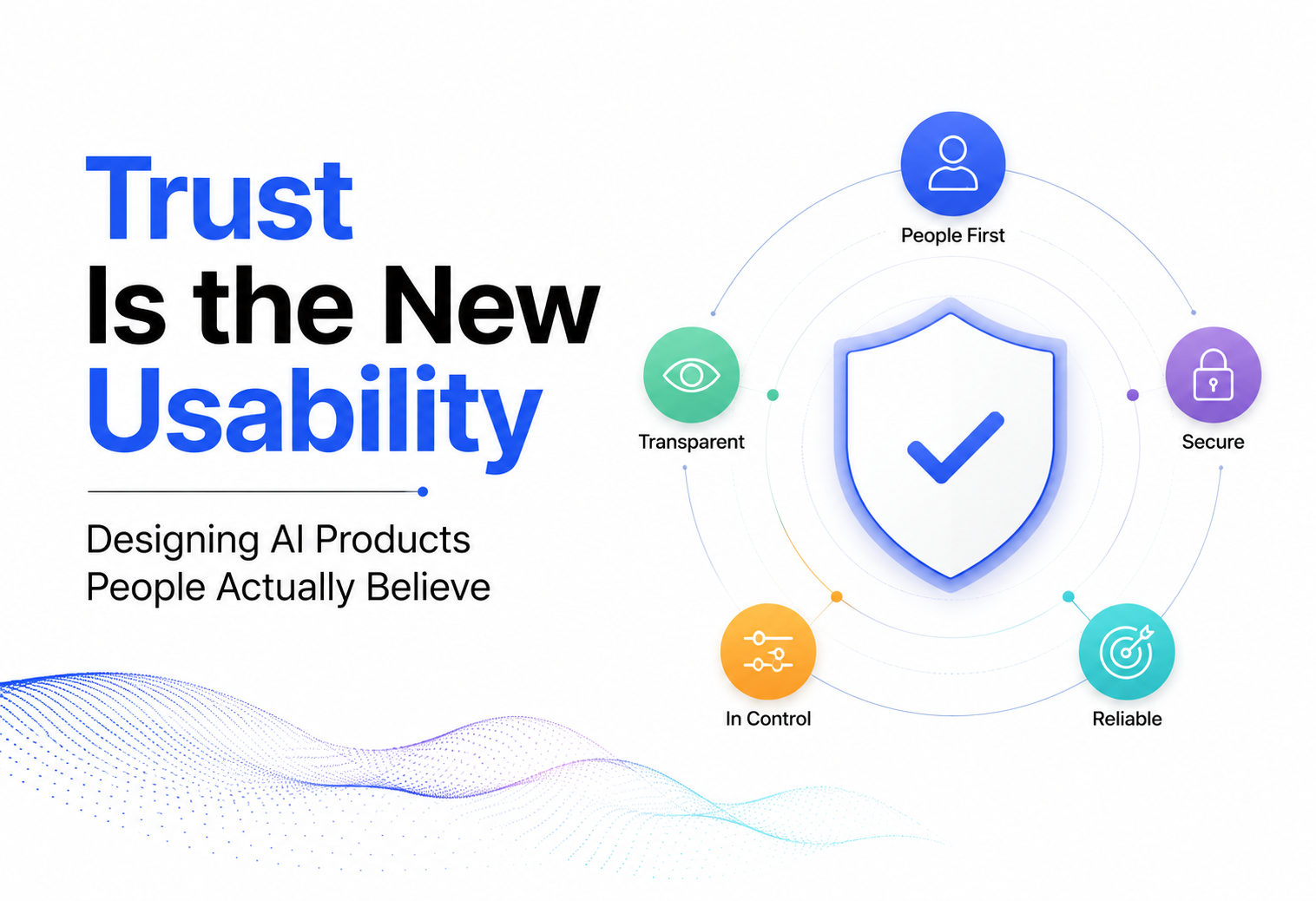
Trust Is the New Usability: Designing AI Products People Actually Believe
The biggest point of failure in modern product design isn’t slow load times, confusing navigation, or clunky layouts—it’s unearned confidence.
In traditional SaaS, usability is about friction reduction: Can the user complete a task in as few clicks as possible? But in AI-driven software, friction reduction backfires when users are asked to blindly trust output they can’t verify.
When an AI product gets something wrong with absolute authority, it doesn’t just fail a task—it triggers algorithm aversion, where a single error causes users to abandon the tool entirely.
If you want to build AI products that survive contact with real users, you need to stop designing for speed and start designing for calibrated reliance.
The 3 Fatal Mistakes Legacy AI Blogs Keep Overlooking
Most product articles tell you to “add a confidence score” or “put a thumbs-up icon at the bottom”. That is surface-level patch work. Here are the root design mistakes breaking trust today:
1. Treating Trust as Pre-requisite Instead of Earned Autonomy
Most AI onboarding flows ask users to hand over total control on day one—”Describe your landing page and let AI build it”. When the initial result misses the mark, the psychological cost of failure is sky-high.
2. The Uncanny Valley of Overconfidence
Large language models are trained to sound authoritative, even when hallucinating. Matching polished prose with inaccurate facts creates a deep sense of betrayal.
3. “Black Box” Execution
When an AI takes an action (like sending an email or adjusting financial budgets), it usually hides its reasoning. Without knowing why something happened, users feel like passive observers rather than active commanders.
The Counter-Intuitive Breakthrough: “Disagreeable by Design”
To overcome these mistakes, we need a shift in philosophy: The best AI interfaces invite human disagreement.
Instead of forcing seamless automation, trustworthy products create controlled friction—moments where the user is encouraged to scrutinize, tweak, or override the system.
┌─────────────────────────────────────────────────────────────┐
│                 THE PROGRESSIVE TRUST DIAL                  │
├─────────────────────────────────────────────────────────────┤
│ Level 1: SUGGEST MODE (AI outlines, human executes)         │
│ Level 2: CONFIRM MODE (AI prepares action, human approves) │
│ Level 3: AUTO MODE    (AI executes within strict guardrails)│
└─────────────────────────────────────────────────────────────┘
The Framework: Progressive Reliance
-
Start with Copilot, Not Autopilot: Begin in Suggest Mode. Let the AI generate outlines, extract context, or propose drafts while the human makes the final decision.
-
Expose the Intent Preview: Before performing any non-reversible action (sending emails, modifying data, moving money), display a clear Intent Preview: “I am about to update 14 customer records. Here is the draft summary before proceeding.”
-
Granular Reversibility: Make corrections take one tap. If fixing an AI error takes longer than doing the work manually, the product has failed.
How AI Can Fix Its Own Trust Deficit
The irony is that AI itself is the best tool for eliminating AI design flaws. By embedding specialized secondary models into the user experience, you can catch errors before they reach the interface.
The Takeaway for Product Teams: Success in AI product design isn’t about getting the model to be 100% accurate—it’s about creating an experience that is 100% predictable and controllable when the model is wrong.